Job Costing for Electrical Projects: How to Track Materials, Labor, and Overhead




Electrical contractors face consistent cost challenges that can quickly erode project margins. Labor costs often exceed initial estimates when apprentices need more supervision than planned or when complex installations take longer than anticipated. Material prices fluctuate between the estimate and purchase date, particularly for copper wire and specialty equipment. Overhead costs like vehicle maintenance, insurance, and administrative time get overlooked or misallocated across jobs.
The result is projects that look profitable on paper but end up losing money in execution. Job costing addresses this by tracking actual expenses against estimates throughout the project lifecycle, giving electrical contractors visibility into where money goes and whether jobs remain profitable.
What is Job Costing for Electrical Contractors?
Job costing is the systematic tracking of all expenses associated with a specific electrical project. It captures three core cost categories: materials (wire, panels, fixtures, conduit), labor (hours worked by electricians and helpers at their respective rates), and overhead (vehicle costs, insurance, tools, permits, administrative time).
The process involves assigning every purchase, timesheet entry, and indirect cost to the correct job code. As work progresses, contractors compare actual costs against the original estimate line by line. This comparison shows whether the job is financially on track or heading toward a loss.
For electrical contractors, job costing transforms financial management from retrospective accounting to active project control. Instead of discovering profit erosion after project completion, contractors identify cost overruns during the work when adjustments are still possible.
Why Job Costing is Critical for Electrical Projects with Tight Margins
Electrical work operates on narrow net profit margins, typically 5-20% after overhead expenses, for commercial projects. While gross margins may reach 55-65%, the net margin is what ultimately determines business viability. Several factors make accurate job costing essential for protecting these margins.
Labor represents a significant portion of project costs in electrical work, often exceeding the 20-40% typical in general construction due to the skilled nature of the trade. A journeyman earning around $35 per hour nationally costs the company approximately $55-60 per hour when benefits, taxes, and insurance are included—a burden rate of 50-60%. If a panel installation estimated at 8 hours actually takes 12 hours, that’s $240 in unplanned labor expense. Across multiple tasks on a $50,000 project, these overruns accumulate quickly.
Material costs fluctuate with commodity markets. Wire costs have increased by 12-15% in recent quarters due to demand and copper market conditions. An estimate created in January may face materially different costs in April when the purchase order goes out. Without job costing, contractors don’t know whether these price changes are absorbed by the estimate buffer or eat into profit.
Change orders create additional complexity. A client requests moving three outlets after the rough-in begins. The change seems minor, but it involves removing installed boxes, patching walls, running new wire, and installing new boxes. Without detailed cost tracking, contractors undercharge for change orders because they don’t capture the true labor and material impact.
Job costing prevents profit leakage by making these costs visible. It also informs future estimating. If panel installations consistently take 25% longer than estimated, that data improves accuracy on the next bid.
How Electrical Contractors Track Materials, Labor, and Overhead

Material Tracking
Effective material tracking starts at purchase and follows through installation. Each material purchase should be coded to the specific job at the time of order or delivery. This includes wire by gauge and type, panels and breakers, conduit and fittings, boxes, switches, fixtures, and specialty items.
Many contractors use a job-specific purchase order system where field supervisors request materials against the job budget. When materials arrive, they’re checked in and allocated. Leftover materials from one job should be returned to inventory rather than informally transferred to another job, which obscures true costs.
Material waste also needs tracking. If a job requires 850 feet of 12-gauge wire but the contractor purchases 1,000 feet in standard spools, that 150 feet of waste is a legitimate job cost. Tracking waste patterns by job type helps refine future estimates.
Labor Tracking
Labor tracking requires capturing which employees worked on which jobs for how many hours, and at which tasks. Daily timesheets should include job codes, task descriptions, and actual hours worked. A journeyman might log 3 hours on rough-in for Job 2401, 4 hours on fixture installation for Job 2387, and 1 hour on service call Job 2390, all in one day.
The tracking should distinguish between productive field time and non-productive time, like travel, material pickup, or waiting for other trades. This distinction helps identify inefficiencies and ensures overhead allocation reflects reality.
For prevailing wage work, labor tracking must be even more detailed to ensure compliance and accurate job costing. Different rates apply to different worker classifications and tasks, requiring precise documentation.
Overhead Allocation
Overhead includes costs that support projects but aren’t directly billed: vehicle expenses, tool depreciation, insurance, office staff, shop rent, utilities, and administrative costs. These must be allocated to jobs to understand true profitability.
The most straightforward allocation method uses a labor burden rate. If annual overhead is $300,000 and billable labor hours are 6,000, the overhead rate is $50 per labor hour. A job that consumes 80 labor hours has a $4,000 overhead allocation.
More sophisticated approaches allocate different overhead types differently. Vehicle costs might be allocated based on mileage logged to each job. Tool costs might be allocated based on the equipment used. Administrative time might be allocated based on job complexity or contract value.
Job Costing vs Job Estimating for Electrical Contractors
Job costing and job estimating are related but distinct processes that electrical contractors sometimes conflate.
Job estimating happens before work begins. It involves calculating expected costs for materials, labor, and overhead, then adding markup to determine the bid price. Estimating relies on historical data, industry standards, takeoffs from drawings, and experience-based assumptions about productivity.
Job costing happens during and after work. It tracks actual expenses as they occur and compares them to the estimate. Job costing answers whether the estimate was accurate and whether the project is profitable at the current trajectory.
The relationship between them is cyclical. Job costing data feeds back into estimating, making future bids more accurate. If job costing reveals that conduit installation consistently costs 15% more than estimated, the estimator adjusts future bids accordingly.
Many electrical contractors carefully estimate but fail to implement job costing, so they never validate their estimates against reality. This creates a disconnect, with the same estimating errors repeating across projects because there’s no feedback loop to correct them.
How Lumber Helps Electrical Contractors Control Job Costs in Real Time
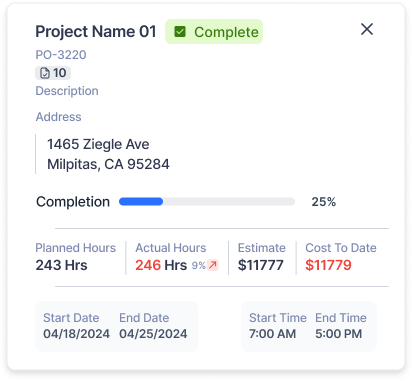
Lumber provides workforce management and job costing capabilities designed for specialty contractors, including electrical firms. The platform focuses on connecting field operations to back-office functions through integrated time tracking, payroll processing, and financial visibility.
The software enables real-time labor cost tracking through mobile time entry. When electricians log hours via the mobile app, those hours flow directly into payroll and job cost tracking at the correct labor rates with appropriate burden calculations. This eliminates manual timesheet entry and ensures labor costs are captured accurately as work happens.
Lumber’s job costing features include budget variance alerts that flag when jobs are tracking over or under estimated costs. Contractors gain visibility into labor hours consumed versus budgeted hours, enabling mid-project adjustments before overruns become severe.
The platform integrates with ERP systems, including Acumatica and Sage, ensuring job cost data syncs with overall financial reporting. This integration prevents duplicate data entry, which often leads to discrepancies between field tracking and accounting records.
Lumber also addresses workforce compliance requirements through its BuilderFax credentialing system, helping electrical contractors manage certifications, licenses, and prevailing wage documentation. While the platform’s primary strengths lie in payroll, scheduling, and labor tracking rather than full estimating modules, these workforce-focused capabilities directly support accurate job costing for labor-intensive electrical projects.
Other Job Costing Tools vs Lumber: What Electrical Contractors Should Choose
Electrical contractors have several options for job costing software, each with different strengths and limitations.
QuickBooks and Generic Accounting Software
QuickBooks offers basic job costing through its contractor edition, allowing expense tracking by job and customer. However, it lacks field-specific features like integrated timesheets, mobile cost capture, and detailed labor burden calculations. Contractors often supplement QuickBooks with separate tools for time tracking and project management, creating integration challenges and data gaps.
Spreadsheets
Some contractors track job costs in Excel or Google Sheets. This approach offers flexibility and low cost but requires manual data entry, which is time-consuming and error-prone. Spreadsheets also lack real-time updates, meaning cost data is often days or weeks behind actual field activity. There’s no automatic connection to payroll or accounting systems.
General Construction Project Management Software
Platforms like Procore and Buildertrend include job costing features but are designed primarily for general contractors managing multiple trades. They often lack the electrical-specific workflows and cost structures that specialty contractors need. The learning curve is steep, and monthly costs are higher than trade-specific alternatives.
Trade-Specific Platforms
Lumber and similar electrical job costing software are built specifically for specialty contractors. These platforms understand electrical workflows, from service calls to large commercial installations. They include features like integrated estimating, change order tracking, and mobile time capture, designed around how electricians actually work.
When choosing between options, electrical contractors should consider integration capabilities, mobile functionality, ease of use for field staff, electrical-specific features, and total cost, including implementation time. A system that requires weeks of training and custom configuration may have lower sticker price but higher true cost than a trade-specific platform that works immediately.
Job costing transforms electrical contracting from reactive to proactive financial management. By tracking actual material, labor, and overhead costs against estimates in real time, contractors identify problems early, protect margins, and make informed decisions about pricing and operations.
The core requirement is systematic tracking. Every material purchase, every labor hour, and every overhead expense must be captured and allocated to the correct job. This discipline creates the data foundation that enables accurate profitability analysis.
Job costing software for electrical contractors makes this tracking practical by automating data capture, eliminating manual entry, and providing real-time visibility into job performance. The investment in software and process pays for itself by preventing profit leakage on current projects and improving estimate accuracy on future bids.
Electrical contractors operating without job costing are managing their businesses through the rearview mirror, discovering profitability problems only after they’ve occurred. Those implementing systematic job costing gain the forward visibility needed to build a consistently profitable electrical contracting business.
Frequently Asked Questions
Why do electrical contractors struggle with job costing?
Electrical contractors struggle with job costing because the work involves numerous small material purchases, multiple workers moving between jobs throughout the day, and overhead costs that are difficult to allocate accurately. Without dedicated systems, tracking becomes overwhelming and gets deprioritized in favor of completing billable work. Many contractors also lack formal training in cost accounting principles.
How do electrical contractors track labor costs accurately?
Accurate labor tracking requires daily timesheets that capture which employees worked on which jobs for how many hours. The system must apply the correct labor rate for each worker classification and add burden for taxes, benefits, insurance, and other employment costs. Mobile time tracking apps help by enabling field staff to log time immediately rather than reconstructing their day later, which improves accuracy.
What materials should be included in electrical job costing?
All materials consumed by the job should be included: wire and cable, conduit and fittings, panels and breakers, boxes and covers, switches and receptacles, fixtures and lamps, connectors and terminals, labels and markers, fasteners and supports, and specialty items specific to the project. Small consumables like wire nuts and tape should also be tracked, either individually or as a percentage applied to larger material costs.
How are overhead costs allocated in electrical job costing?
Overhead costs are typically allocated using a labor burden rate calculated by dividing total annual overhead by total billable labor hours. Some contractors use more sophisticated methods that allocate different overhead types based on different drivers: vehicle costs by mileage, tool costs by equipment used, or administrative time by job complexity. The key is consistency in application across all jobs.
Is job costing software necessary for electrical contractors?
Job costing software becomes necessary as soon as manual tracking becomes too time-consuming or error-prone. For single-person operations doing only a few jobs per month, spreadsheets may suffice. Once a contractor has multiple employees running concurrent jobs, software is practically essential. The alternative is incomplete cost data, which leads to unprofitable jobs and inaccurate estimates.
What features should electrical job costing software have?
Essential features include mobile time tracking, material cost capture at purchase, budget versus actual reporting by line item, change order tracking, labor burden calculation, integration with accounting software, and job profitability analysis. Electrical-specific features like service call tracking, T&M billing integration, and prevailing wage compliance add significant value for contractors doing that type of work.
Lorem ipsum dolor sit amet, consectetur adipiscing elit. Donec ullamcorper mattis lorem non. Ultrices praesent amet ipsum justo massa. Eu dolor aliquet risus gravida nunc at feugiat consequat purus. Non massa enim vitae duis mattis. Vel in ultricies vel fringilla.
Introduction
Mi tincidunt elit, id quisque ligula ac diam, amet. Vel etiam suspendisse morbi eleifend faucibus eget vestibulum felis. Dictum quis montes, sit sit. Tellus aliquam enim urna, etiam. Mauris posuere vulputate arcu amet, vitae nisi, tellus tincidunt. At feugiat sapien varius id.
Eget quis mi enim, leo lacinia pharetra, semper. Eget in volutpat mollis at volutpat lectus velit, sed auctor. Porttitor fames arcu quis fusce augue enim. Quis at habitant diam at. Suscipit tristique risus, at donec. In turpis vel et quam imperdiet. Ipsum molestie aliquet sodales id est ac volutpat.


Ipsum sit mattis nulla quam nulla. Gravida id gravida ac enim mauris id. Non pellentesque congue eget consectetur turpis. Sapien, dictum molestie sem tempor. Diam elit, orci, tincidunt aenean tempus. Quis velit eget ut tortor tellus. Sed vel, congue felis elit erat nam nibh orci.

Dolor enim eu tortor urna sed duis nulla. Aliquam vestibulum, nulla odio nisl vitae. In aliquet pellentesque aenean hac vestibulum turpis mi bibendum diam. Tempor integer aliquam in vitae malesuada fringilla.
Elit nisi in eleifend sed nisi. Pulvinar at orci, proin imperdiet commodo consectetur convallis risus. Sed condimentum enim dignissim adipiscing faucibus consequat, urna. Viverra purus et erat auctor aliquam. Risus, volutpat vulputate posuere purus sit congue convallis aliquet. Arcu id augue ut feugiat donec porttitor neque. Mauris, neque ultricies eu vestibulum, bibendum quam lorem id. Dolor lacus, eget nunc lectus in tellus, pharetra, porttitor.
Ipsum sit mattis nulla quam nulla. Gravida id gravida ac enim mauris id. Non pellentesque congue eget consectetur turpis. Sapien, dictum molestie sem tempor. Diam elit, orci, tincidunt aenean tempus. Quis velit eget ut tortor tellus. Sed vel, congue felis elit erat nam nibh orci.
Mi tincidunt elit, id quisque ligula ac diam, amet. Vel etiam suspendisse morbi eleifend faucibus eget vestibulum felis. Dictum quis montes, sit sit. Tellus aliquam enim urna, etiam. Mauris posuere vulputate arcu amet, vitae nisi, tellus tincidunt. At feugiat sapien varius id.
Eget quis mi enim, leo lacinia pharetra, semper. Eget in volutpat mollis at volutpat lectus velit, sed auctor. Porttitor fames arcu quis fusce augue enim. Quis at habitant diam at. Suscipit tristique risus, at donec. In turpis vel et quam imperdiet. Ipsum molestie aliquet sodales id est ac volutpat.
Mi tincidunt elit, id quisque ligula ac diam, amet. Vel etiam suspendisse morbi eleifend faucibus eget vestibulum felis. Dictum quis montes, sit sit. Tellus aliquam enim urna, etiam. Mauris posuere vulputate arcu amet, vitae nisi, tellus tincidunt. At feugiat sapien varius id.
Eget quis mi enim, leo lacinia pharetra, semper. Eget in volutpat mollis at volutpat lectus velit, sed auctor. Porttitor fames arcu quis fusce augue enim. Quis at habitant diam at. Suscipit tristique risus, at donec. In turpis vel et quam imperdiet. Ipsum molestie aliquet sodales id est ac volutpat.
- Lectus id duis vitae porttitor enim gravida morbi.
- Eu turpis posuere semper feugiat volutpat elit, ultrices suspendisse. Auctor vel in vitae placerat.
- Suspendisse maecenas ac donec scelerisque diam sed est duis purus.
Lectus leo massa amet posuere. Malesuada mattis non convallis quisque. Libero sit et imperdiet bibendum quisque dictum vestibulum in non. Pretium ultricies tempor non est diam. Enim ut enim amet amet integer cursus. Sit ac commodo pretium sed etiam turpis suspendisse at.
Tristique odio senectus nam posuere ornare leo metus, ultricies. Blandit duis ultricies vulputate morbi feugiat cras placerat elit. Aliquam tellus lorem sed ac. Montes, sed mattis pellentesque suscipit accumsan. Cursus viverra aenean magna risus elementum faucibus molestie pellentesque. Arcu ultricies sed mauris vestibulum.

Essential resources for contractors